



SEO strategies have long focused on creating valuable, reader-first content for a brand’s website, with off-site content marketing often treated (and resourced) as a secondary tactic or afterthought.
But large language models (LLMs) rely heavily on third-party sources to discover, evaluate, and recommend brands, making credible coverage, mentions, and backlinks across the wider web mission critical to visibility in traditional and AEO, GEO, and AI search.
In this guide, we’ll explain why and outline how to create content that builds authentic brand visibility, drives qualified traffic, and generates leads at scale.
What Is Off-Site Content Marketing?
Off-site content marketing involves creating valuable content designed to earn placements or mentions on third-party platforms and websites, not just on your brand’s domain.
It can take several forms, including:
Depending on the format, a publisher, platform, or community may control how the content appears and reaches its audience. The common thread is that each format extends your expertise—and brand visibility—beyond your website.
Why Off-Site Content Marketing Matters
Off-site content marketing has long influenced SEO rankings. Since launching PageRank in 1998, Google has analysed links—including those between independent websites—to understand pages and assess their usefulness. Its link-analysis systems remain part of Google’s core ranking systems today.

It has become even more vital in recent years because LLMs such as ChatGPT, Claude, and Google’s AI Overviews rely heavily on third-party sources to evaluate companies and determine which ones to mention, cite, or recommend. An Ahrefs analysis of 75,000 brands found that web mentions had the strongest correlation with visibility in Google AI Overviews. Another study of more than 167,000 citations found that 85.7% pointed to websites the featured brand did not own.
>> DOWNLOAD: How Scaling B2B Brands Win in AI Search
Off-site content also plays an important role in how consumers view your brand. Forrester research found that up to 72% of B2B buyers trust independent experts, including industry peers, analysts, vendor executives, and customers, while an Edelman–LinkedIn study found that more than half of target buyers use thought leadership when evaluating vendors.
Of course, off-site content is often harder to produce and publish than content on your website. You have to offer something unique, novel, and valuable, meet certain editorial standards, and persuade the right gatekeeper that your contribution deserves space.
You also need to avoid spammy tactics, such as mass-pitching irrelevant contacts, forcing promotional links into contributed articles, or flooding communities with undisclosed brand content.
These practices can damage relationships, violate publisher or platform rules, earn SEO or AI search penalties, and ultimately undermine the trust and authority your brand is trying to build.

Eleven Content can help you develop original ideas, identify placement opportunities, and manage outreach that earns authentic coverage, backlinks, and brand mentions.
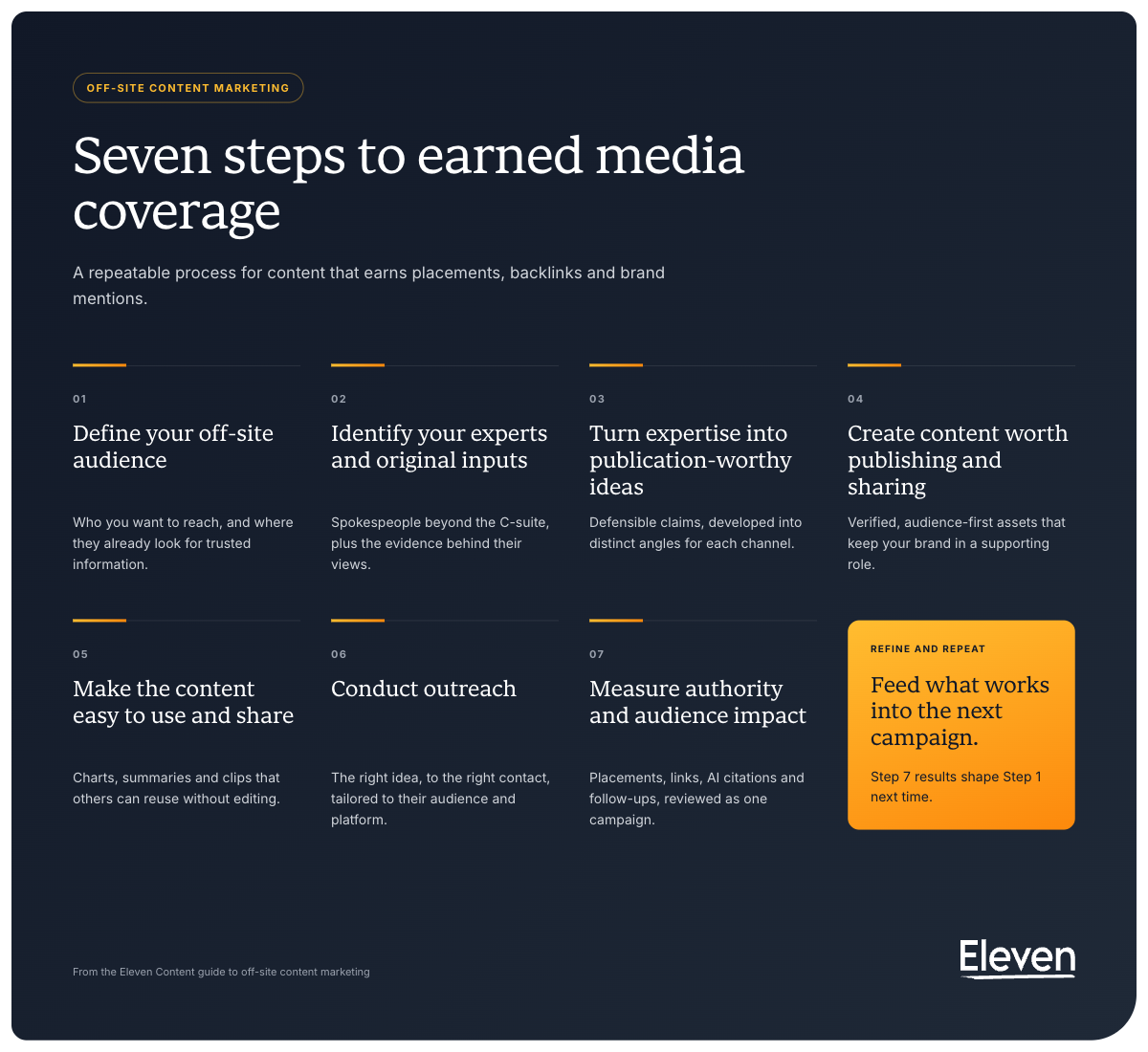
7 Steps to Earned Media Coverage
Here are seven steps you and your team can put in place today to start earning greater visibility through earned media coverage.
1. Define Your Off-Site Audience
Placing and producing off-site content takes work. Your marketing team must research platforms, develop a strong pitch, identify and reach out to the right content, and, in some scenarios, create a full asset for a new audience and set of editorial standards. Even then, results aren’t guaranteed.
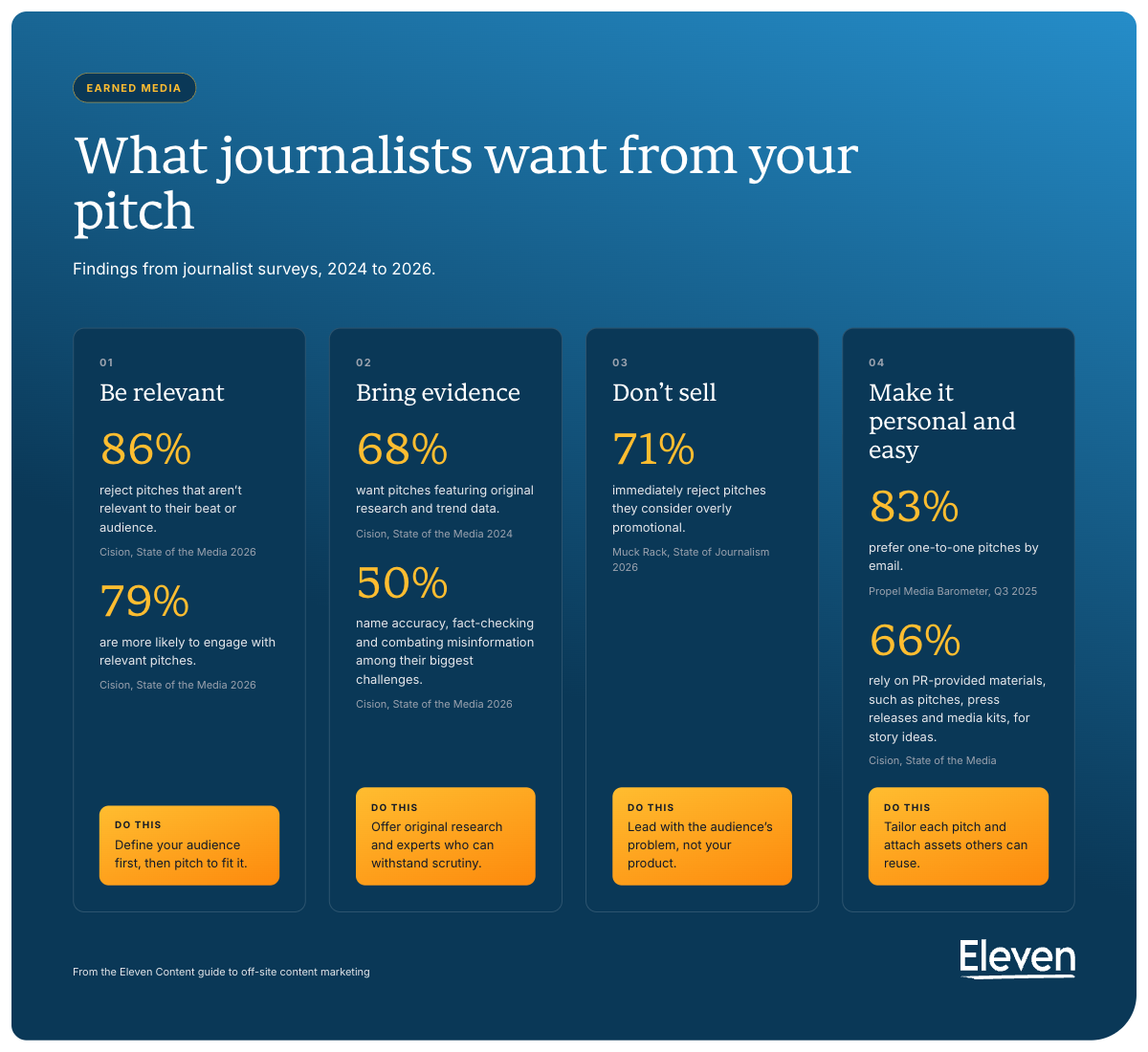
That’s why audience fit is critical. It ups your odds of securing coverage: Cision’s 2026 State of the Media Report found 86% of journalists reject pitches that aren’t relevant to their beat or audience. In contrast, 79% are more likely to engage with relevant pitches.
Relevance also gets your brand in front of the readers, viewers, or listeners most likely to become customers.
To minimise wasted effort, define exactly whom you want to reach and where they already look for trusted information before developing ideas or pitching placements. Here’s how.
Write an audience-and-outcome statement
Create a short statement using this formula:
We want [specific audience] to recognise [our brand] as a credible source on [subject] so they can [desired outcome].
Keep the audience narrow. “HR professionals” is too broad; “HR leaders managing hourly employees across multiple locations” provides more direction.
The desired outcome should describe the value for that audience, not your marketing goal. “Understand how to reduce scheduling-related compliance risks” is more useful for content planning than “generate leads,” for instance.
This chart illustrates what meaningful audience-and-outcome statements might look like for companies across several industries.
Identify where your audience already pays attention
Next, determine which platforms your audience uses and trusts for information, professional development, and peer discussion. Consider three broad categories:
- Media outlets: Publications, newsletters, podcasts, and broadcast programs
- Communities: Forums, social groups, and practitioner networks
- Associations: Professional bodies that publish research and resources or host programs and events
- Event organisers: Companies and industry groups that run conferences, trade shows, webinars, roundtables, and other programs featuring external speakers or contributors
Use your audience-and-outcome statement to guide the research. Ask customers and sales teams which sources they trust, then review industry-event speakers, trade-media citations, and platforms that frequently appear in relevant Google and AI-search results.
For each platform, determine whether it:
- Accepts guest articles or op-eds
- Features outside experts
- Books podcast, webinar, or panel guests
- Publishes partner or member resources
- Co-creates research, guides, or events
- Cites original reports, data, or tools
- Hosts expert discussions, AMAs, or community contributions
These preferences will help you decide whether to propose new content, offer an expert, or pitch an existing source asset for coverage.
The chart shows where select audiences might already seek information and advice.
2. Identify Your Experts and Original Inputs
Media outlets, associations, and online communities can be hard to sell to. They have audiences, standards, and reputations to protect, so they’re unlikely to publish generic commentary, unsupported claims, or overly promotional content.
You’re more likely to gain coverage or traction by offering credible expertise, original evidence, and hyper-relevant insights. Case in point: Cision found that 68% of journalists wanted pitches featuring original research and trend data.
Your experts and evidence must also withstand public scrutiny, as 42% of journalists cite maintaining credibility as their biggest challenge. Publishers need knowledgeable spokespeople who communicate clearly and original findings that withstand fact-checking.
These steps can help you identify the right internal subject matter experts, gather defensible insights, and prepare for external opportunities.
Audit your organisation’s expertise
Look beyond the executive team when identifying spokespeople. A senior title may attract attention, but executives don’t always have the time or firsthand knowledge for every media opportunity. Employees closer to your products, customers, and day-to-day operations may offer more useful detail and respond faster.
Ask department heads to nominate people with relevant experience, then record what each person knows and which formats suit them.
Say you’re planning a PR strategy at a B2B SaaS company. Your working list of potential spokespeople might look like this:
Gather evidence & identify themes
Once you’ve identified potential experts, capture the knowledge behind their credentials. Depending on their availability and communication preferences, you can collect insights through:
- One-on-one interviews
- Recorded voice notes
- Written questionnaires
- Meeting and presentation transcripts
- Relevant Slack or Teams conversations
- Small expert roundtables
- Recorded product demonstrations
- Existing reports, research, and internal documents
Ask questions that will uncover specifics rather than generic insights. Say you lead content at a project-management software company and want to gather material for future thought leadership articles in business and technology publications. You might ask:
- Which project-management problems do customers underestimate?
- What commonly recommended productivity advice fails in practice?
- Why do some software rollouts succeed while others stall?
- Which software rollout changed how you understand user adoption?
- Which customer behaviours or product-usage patterns have surprised you?
- What recurring problem appears in support or sales conversations?
- Which emerging trend will most affect project teams over the next year?
- What internal data or customer evidence supports your view?
After each conversation, store the transcript or notes alongside any supporting data, examples, and source documents.
3. Turn Expertise Into Publication-Worthy Ideas
A collection of transcripts and internal documents is valuable source material, but it’s not a full-fledged pitch or concept. You’ll need to parse through your research to find the claims, patterns, and evidence that are most useful for an external audience.
Synthesise your research
Review your collected insights and tag noteworthy insights by:
- Audience problem or decision
- Expert observation or argument
- Firsthand example
- Supporting data or evidence
- Contradiction or disagreement
- Timely development
- Potential quotation
- Claim requiring verification
You can complete the exercise manually with a spreadsheet, shared document, or research database. Use consistent labels and link each insight to its source so you can compare and verify all findings later.
For example, if you’re analysing research for the project-management software company, you could categorise comments about unclear ownership, limited manager training, and employee resistance under the shared tag “implementation barriers.”
Build a shortlist of defensible ideas
Once you’ve organised your source material, look for claims that:
- Appear independently across multiple sources
- Challenge a common assumption or established practice
- Reveal an overlooked problem, cause, or consequence
- Explain why experts or existing evidence disagree
- Connect internal data with firsthand observations
- Answer a recurring audience question
- Have enough evidence to withstand scrutiny
These claims likely represent your strongest, most compelling ideas. Summarise each in a few sentences explaining what you found, why an external audience would care, and what evidence, expertise, or practical resources your organisation can contribute.
So, returning to the project-management software example, one summary could read:
Managers frequently blame poor software adoption on employee resistance. However, expert interviews, support questions, and usage data suggest that unclear ownership is often the bigger problem. Our team can contribute implementation insights and a practical framework for assigning responsibility during software rollouts.
This step gives you a clear story idea without prematurely turning it into a formal pitch.
Develop multiple angles from each idea
Off-site campaigns require substantial research, expert involvement, content development, and outreach. To get more value from that investment, consider how each idea could serve several distinct audiences and channels.
The strongest ones are those you can adapt without diluting the central claim or reducing their likelihood of earned coverage. Several outlets may cover the same original report. Contributed articles and other original placements typically require distinct angles or treatments.
To develop those variations, keep the underlying evidence consistent while changing the audience, question, practical takeaway, or format. For example, the project-management software idea could support these formats.
Each angle provides meaningful value to its intended audience rather than simply changing the headline. Together, they give you several routes to coverage, mentions, and backlinks from the same body of research.
4. Create Content Worth Publishing and Sharing
Your content will vary based on where it lives (e.g., your website or trade media), who controls it (e.g., you or a publisher), and whether you create it before or after securing a placement.
The more common publishing models and approaches include:
The big common denominator at play? Each asset must offer credible, well-supported, and relevant value to its intended audience.
These quality-control measures can help you meet those standards.
Deliver on the central idea
Build the asset around a clear promise to its audience. Lead with the strongest insight in the headline and introduction, then use the body to explain its significance, present the evidence, and offer actionable guidance from your experts.
For example, if an analysis of customer data finds that companies adding more project-management tools complete fewer projects on time, make that your headline and opening sentence.
Avoid burying this hook beneath generic background or diluting it with loosely related material. In this case, statistics on the growth of the project-management software market add little unless they directly explain the finding.
Verify evidence and attribution
Editors and journalists risk their credibility when they use information from a brand. In Cision’s 2026 State of the Media survey, 50% of reporters identified accuracy, fact-checking, and combating misinformation as one of their biggest challenges.
Any content you pitch must undergo and withstand rigorous fact-checking. If an outlet has to issue a correction or, worse, a retraction because of information you supplied, its editors are unlikely to cover your brand or consider future contributions. You could also face broader reputational risk.
To reduce the risk of errors, take the following steps before publication:
- Trace statistics and factual claims to their sources.
- Confirm quotations, names, titles, and credentials.
- Include a methodology for proprietary findings.
- Preserve caveats, limitations, and relevant context.
- Distinguish facts from opinions, estimates, and inferences.
- Secure permission to use customer information or identifiable examples.
- Disclose commercial relationships and AI assistance where necessary.
For example, before publishing an original software-adoption report, verify the survey totals against the raw responses, ask an analyst to reproduce the calculations, and have participating experts approve their quotations. Then publish the sample size, field dates, methodology, and relevant limitations alongside the findings.
Keep Your Brand in a Supporting Role
Publishers are unlikely to feature content that reads like an advertisement: Muck Rack’s 2026 State of Journalism report found that 71% of journalists immediately reject pitches they consider overly promotional.
Readers are also more likely to trust content that helps them solve a problem than content that pushes a sales message.
To strike the right balance:
- Lead with the audience’s problem rather than your product.
- Use company data or experience as evidence, not your full argument.
- Mention your products if and only when they materially support the point.
- Replace unsupported claims with specific examples or verified results.
- Link to relevant research or resources rather than sales pages.
- Keep promotional calls to action out of contributed editorial content.
- Disclose commercial relationships and other relevant interests.
So, going back to that finding that companies adding more project-management tools complete fewer projects on time, focus on explaining the pattern instead of positioning your platform as the solution. Your product data and expertise can support the analysis without turning it into a sales pitch.
Meet the platform’s other editorial requirements
Review the platform’s contributor guidelines and recent content before production begins. Match its requirements for format, length, tone, sourcing, disclosures, and audience while confirming deadlines, review stages, and approval rights.
For example, a trade publication may require an 800-word contributed article written in AP Style with links to primary sources, and no promotional call to action. At the same time, a podcast producer may request three talking points, a short biography, and real-world examples the host can probe during the interview.
For co-created content, agree on responsibilities, attribution, and final approval before drafting. For example, a software company and professional association co-producing a benchmark report might assign data analysis to the company, editorial review to the association, and final sign-off to both parties.
5. Make the Content Easy to Use & Share
Strong content is easier to place and more likely to travel when other people can quickly understand and reuse its valuable elements. Key findings and infographics help publishers evaluate an idea, while social-media graphics and short videos encourage readers to share it.
Cision found that 66% of journalists rely on PR-provided materials, including pitches, press releases, and media kits, for story ideas. At the same time, LinkedIn reports that video posts are shared 20 times more than other content formats on its platform.
These steps can help you package your work for easier evaluation and wider distribution.
Plan supporting assets early
Consider shareability while developing the central idea. That way, you have time to collect the necessary data, permissions, and verified source material.
Ask which findings, quotations, frameworks, demonstrations, or practical resources could provide value in another format. Depending on the project, these resources might include:
- Charts or infographics for data and comparisons
- Social graphics for key statistics or quotations
- Executive summaries for longer reports
- Short videos or audio clips for expert explanations
- Screenshots or demonstrations for product workflows
- Checklists, templates, or tools for practical guidance
- Press releases for timely findings and expert commentary
For example, a software-adoption report could include a downloadable chart comparing completion rates by number of tools, a checklist for evaluating tool sprawl, and a short video in which the lead researcher explains the results.
Produce publication-ready versions
Create each asset so another organisation or individual can use it without substantial editing. Follow the channel’s specifications, use legible text and high-resolution media, and include enough context to prevent misinterpretation.
Attribute quotations, add captions or transcripts to video and audio, and label charts with their source, units, and sample size.
For example, a LinkedIn graphic about software completion rates should state the sample size, define “completed on time,” and include clear attribution, such as “Source: [Company Name] 2027 Software Adoption Report.”
6. Conduct Outreach
Outreach is its own discipline, with enough strategy and nuance to warrant a separate guide. Still, even exceptional content rarely earns third-party placements through quality alone. You must bring the right idea to the right person and make its value immediately clear.
These basic best practices can improve your chances of successfully moving from pitch to publication.
Find the right contact
Identify the person most directly responsible for covering or approving the subject and your proposed format. Depending on the model, that contact may be:
- A reporter covering your industry or subject
- An editor responsible for contributed articles
- A producer booking podcast or webinar guests
- An association’s content or education director
- A newsletter editor
- A community manager or moderator
- A partner responsible for co-marketing
You can find the most relevant person by reviewing recent bylines, outlet mastheads, podcast credits, and association staff pages. Check contributor guidelines or submission pages first, as they may specify the correct editor, form, inbox, or process.
Media databases like Muck Rack, Cision, and Prowly help you search journalists by beat and recent coverage, while tools like Hunter can help verify professional email addresses.
Tailor the pitch
While it’s tempting to copy and paste a message across your contact list, publishers, producers, association leaders, and community managers generally expect outreach tailored to their audience and platform. Propel found, for instance, that 83% of journalists prefer one-to-one pitches by email.
Adapt your general framing to the recipient’s recent work, priorities, and audience. Each pitch should include:
- An informative subject line
- The central finding or proposed angle
- Why it matters now and to that particular audience
- The research, expert access, or supporting assets you’re offering
- Your proposed format or contribution
- A clear next step
Say you’re pitching research showing that most community banks take several days to resolve customers’ disputed transactions. You could position it as a data-led customer-service story for a banking publication, a dispute-resolution webinar for a banking association, and an expert discussion about improving fraud investigations for a fintech podcast.
7. Measure Authority and Audience Impact
Measuring authority and audience impact allows you to identify which ideas and formats earn placements, reach the right audiences, and improve brand visibility across search and other marketing channels. Then. use those findings to refine future campaigns and invest in what works.
Admittedly, measuring off-site content marketing can be tricky. A Cision–PRWeek survey found that 37% of communications leaders struggle to demonstrate results, largely because individual efforts can be difficult to connect to broader business goals.
>>MORE: 5 Common Challenges in Attribution Reporting (And How to Solve Them)
It can help to remember (or reiterate to your organisational leaders) what these campaigns are designed to achieve. Namely, an op-ed, podcast interview, or article quote may not generate an immediate lead, but it can strengthen brand recognition, earn backlinks, establish your experts as trusted sources, and holistically improve search performance in the long term.
These steps can help you choose meaningful metrics and interpret them in context.
Match metrics to the opportunity
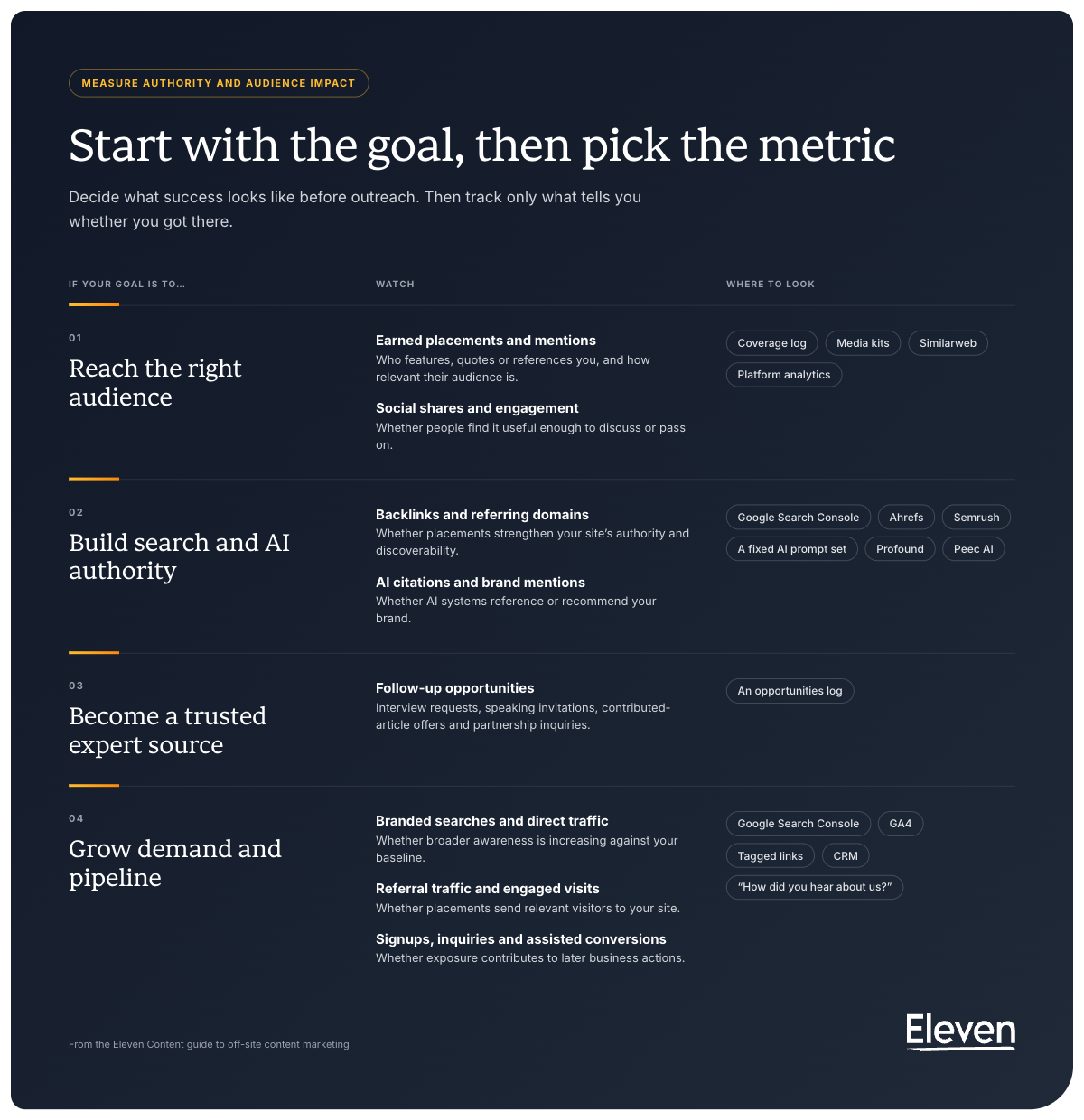
Decide what success looks like before outreach, then choose metrics that match your desired outcomes. For example, if you co-publish a fraud-prevention report with a community banking association, you might track report downloads, referral visits from the association, backlinks from banking publications, and invitations for your experts to discuss the findings.
The following chart outlines common off-site content marketing metrics, what they reveal, and how to track them.
Evaluate the campaign as a whole
Review related placements collectively rather than expecting each one to generate every desired result. For example, a podcast might introduce your expert to a new audience, a trade article could earn a valuable backlink, and an association webinar may lead to further speaking opportunities.
Set regular review points and compare results with your pre-campaign baseline. Look for the ideas, formats, experts, and platforms that consistently produce meaningful outcomes, then apply those findings to future campaigns.
For example, if data-led articles featuring your fraud specialist consistently earn banking-press coverage and backlinks, prioritise that expert and format in your next ideation session.
Take Your Expertise Beyond Your Website
Creating valuable off-site content takes more than republishing ideas from your blog. You need credible experts, original insights, and a targeted strategy for reaching the publications, platforms, and communities your audience trusts.
Eleven can help with every aspect of off-site content marketing, from uncovering internal expertise and developing original ideas to creating content and securing placements. It’s a key part of “Expertise, Everywhere,” our bespoke approach to content marketing.
Contact Eleven today to discuss how off-site content can expand your brand’s reach and authority.
Receive insider tips straight to your inbox.

Receive insider tips straight to your inbox.

Would you like to speak to one of our experts?
Create custom email campaigns, measure performance, and turn insights into results with Mailchimp’s email marketing tools.
