



Even the best content can go unnoticed—a challenge that existed long before large language models (LLMs) made it faster and cheaper to produce content at scale. Brands now need to work even harder to help their audiences (and potential customers) find their most compelling stories and assets.
Our work with B2B brands has shown that just a few repeatable strategies can make content distribution much easier and far more effective.
In this guide, we’ll cover eight content distribution strategies, including onsite promotion, earned media, newsletters, and community engagement, that can help your brand get more value from every asset, plus practical steps for actioning on each one.
What Is a Content Distribution Strategy & Why Does It Matter?
The ultimate goal of content creation is to produce valuable assets that customers see. Content distribution gets those assets in front of the people most likely to benefit from or be influenced by it. A content distribution strategy formalises that process and involves defining your audience, identifying their preferred platforms or channels, and planning how and when to promote each asset.
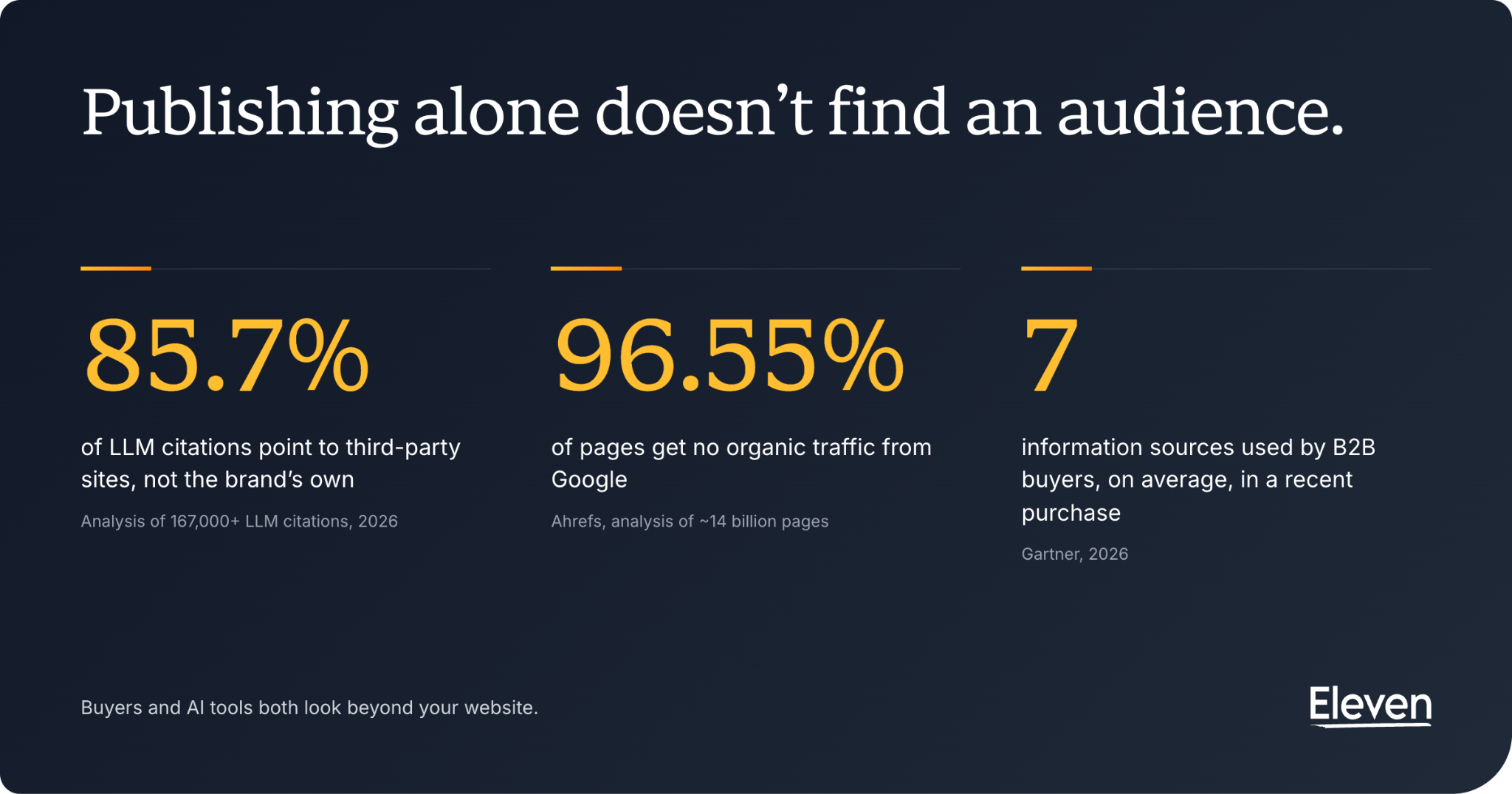
Content distribution has long been integral to content marketing, as merely publishing a piece doesn’t guarantee an audience. In fact, an Ahrefs analysis of roughly 14 billion pages found that 96.55% received no organic traffic from Google.
Research also shows that brands benefit from showing up across multiple platforms their audience trusts. For example, a 2026 Gartner survey found that B2B buyers used an average of seven information sources during a recent purchase.
Beyond that, content distribution has taken on new significance in recent years, as it’s become integral to AI search visibility. One 2026 analysis of more than 167,000 LLM citations found that 85.7% pointed to third-party websites rather than the featured brand’s domain.
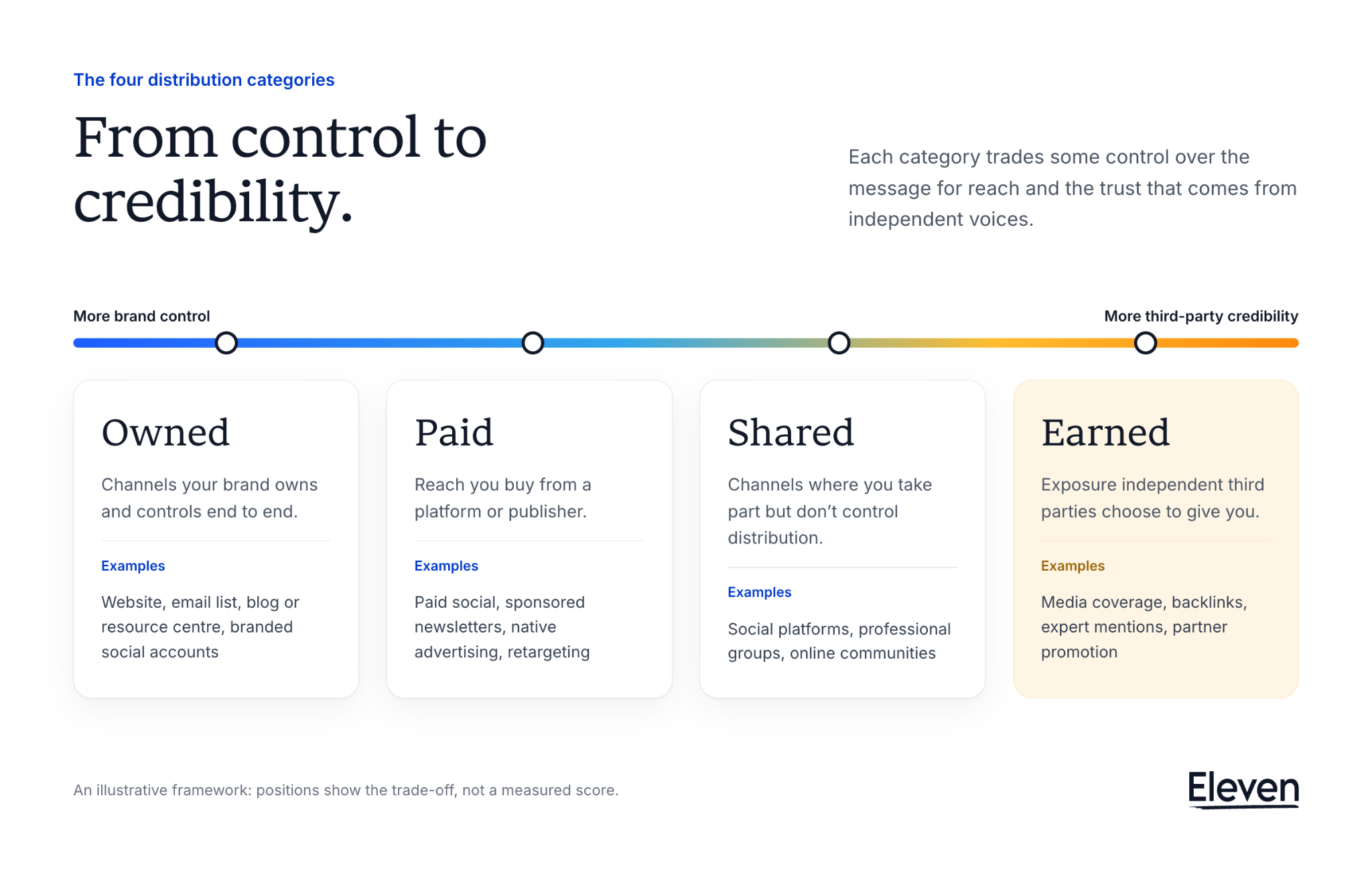
Distribution generally falls into four categories, each offering a different balance of control, reach, and third-party credibility. They include:
These steps can help you prioritise the right mix of channels and build repeatable distribution into your content strategy.
1. Improve Onsite Discovery
One of the easiest distribution methods involves better leveraging the traffic your website already receives. Strategic placements can introduce visitors to valuable assets they might otherwise miss, while guiding them toward related resources and next steps.
Onsite promotion can also support SEO. Google recommends linking to important content from other relevant pages to help users and search engines find it.
Here are quick ways to improve on-site discovery.
Feature your best assets
Start by identifying content worth promoting. Review Google Analytics and Search Console to find assets that already drive traffic and engagement, and check your backlink data in Ahrefs or Semrush to identify those earning links from other websites.
Also consider strategically important content, such as original research, industry reports, and upcoming webinars, that could benefit from more exposure.
Next, feature those assets by:
- Highlighting flagship reports or upcoming webinars on your homepage.
- Adding contextual links to related resources within popular blog posts.
- Using banners or callout boxes to promote relevant research and downloadable guides.
- Creating resource hubs that organise content by topic, industry, or audience need.
For example, a cybersecurity company might promote its annual threat report within articles about ransomware and data breaches that rank well in Google Search, reaching organic visitors with a proven interest in those topics.
Create clear conversion paths
Use relevant internal links, in-content calls to action (CTAs), and strategically placed sign-up forms or buttons to guide visitors to a next step, whether that's exploring a related topic, subscribing to your newsletter, downloading a resource, or requesting a demo.
Match each CTA to the content and the reader's likely intent. Someone reading an introductory guide may appreciate a practical checklist, while a visitor comparing software solutions might be ready for a product demonstration.
For example, a project-management software provider could link from an article about improving team productivity to a free workflow template, then offer a product demo on the template's download confirmation page.
Review your most-visited pages for missing or poorly placed CTAs, then track clicks and conversions to see which perform best. Use those findings to adjust CTA wording, placement, and design, testing different approaches to improve results.
For example, if you find mid-article CTAs consistently outperform those at the end, test that placement across more pages.
2. Activate Executives and Employees
Executives, subject matter experts (SMEs), and sales representatives can introduce your content to audiences that don't follow your company accounts, while adding personal perspectives that encourage engagement.
In fact, LinkedIn research found that employee-shared content received twice the click-through rate of the same content shared by company pages. The key is to streamline participation and encourage employees to contribute their expertise rather than simply reposting company updates.
Here are ways to put your team's networks and knowledge to work.
Identify in-house subject matter experts
Start by identifying executives and employees whose expertise aligns with your content and target audience. Look beyond senior leadership to include technical specialists, product managers, researchers, and other practitioners with valuable first-hand experience.
For example, a cybersecurity company could ask its security engineers to share findings from a new threat report on LinkedIn, adding their observations about the top business risks.
To drive participation:
- Share relevant assets with employees who can add informed perspectives.
- Supply key findings, graphics, and links to make sharing easier.
- Ask employees to explain what a finding means, challenge an assumption, or share a related experience.
- Offer guidance and support without requiring employees to post or follow rigid scripts.
Prioritise a small group of willing contributors rather than expecting everyone to participate. Over time, their activity can help build their professional reputations and your brand's visibility.
Leverage your sales team
Sales representatives have direct relationships with customers and understand the questions, objections, and challenges that come up during the buying process. That makes them valuable content distribution partners.
Work with sales leaders to identify assets that support common buyer needs, then make those resources easy to find and share.
For example, a CRM sales representative might notice that prospects frequently raise concerns about data migration. They could suggest creating a practical migration checklist, then share the finished resource with prospects facing that challenge.
Other ways to involve (and assist) sales include:
- Reengage stalled prospects with new research or relevant industry developments.
- Encourage experienced sales leaders to speak at industry conferences or appear on podcasts, using company research and insights to support their presentations.
- Ask reps to share content on LinkedIn, adding insights from customer conversations.
- Create a process that makes it easy for sales reps to find and incorporate relevant content into presentations, proposals, and email sequences.
3. Run Strong Earned-Media Campaigns
Earned media puts your brand's expertise in front of new audiences through independent publications, podcasts, newsletters, and other third-party channels.
Unlike paid placements, you secure this coverage on editorial merit, making it a valuable source of credibility, backlinks, and brand mentions that can strengthen organic and AI search visibility.
The challenge is convincing journalists and editors that your content deserves attention. According to Cision's 2026 State of the Media Report, 86% of journalists reject pitches that aren't relevant to their beat or audience.
Here are three ways to improve your chances of earning coverage.
Identify your strongest hooks
Start by reviewing your existing content for assets that offer something journalists can't easily find elsewhere, such as original research, proprietary data, or first-hand expert insights. Prioritise content that addresses timely industry issues or challenges your audience cares about.
Next, look for findings that make a compelling story. For example, a workforce-management software company might identify an unexpected relationship between last-minute scheduling changes and employee turnover in its latest research report.
That finding could become the focus of a media pitch, supported by additional data and expert commentary, rather than asking journalists to cover the whole report.
Target outlets your audience reads
Focus on publications, podcasts, and newsletters that reach your prospective customers rather than chasing the largest audiences. For instance, an HR software company might prioritise HR Dive or HR Executive over a general business publication, even if the latter attracts more readers.
To identify the most relevant publications, ask customers and sales teams what they read, review where competitors earn coverage, and identify outlets that regularly cover your subject by utilising a few Google searches.
Personalise outreach and follow-up
Find journalists covering your topic by searching relevant publications, reviewing recent bylines, or using media databases like Muck Rack. Then, review their recent work to understand their interests and reporting style.
Keep your pitch short and specific. Explain why the story matters to their readers, include a link to your supporting research, and offer access to an expert who can answer questions or provide context.
For example, the workforce-management company could pitch its scheduling research to an HR journalist like so:
Hi [Name],
I saw your recent coverage of employee retention challenges and thought you might be interested in our new research.
We found a strong link between last-minute shift changes and employee turnover, with some surprising differences across industries.
You can see the findings here: [Report link].
Our workforce expert is also available to discuss how employers can improve scheduling and retention.
Would this be of interest?
Best,
[Name]
If you don't hear back, follow up once, ideally with a useful new detail. Avoid mass emails, generic pitches, and repeated follow-ups that can damage media relationships.
4. Build & Engage a Newsletter Audience
I've long encouraged brands I've worked with to build an email newsletter alongside their organic and AI search strategies. That's largely because newsletters offer something few other content marketing channels can: a direct, ongoing relationship with an audience that has chosen to hear from you.
While search helps people discover your content, newsletters let you keep engaging those visitors after they've left your website. And, unlike social media, where algorithms determine which followers see your posts, email newsletters let you reach subscribers directly in their inboxes.
They're particularly valuable for B2B brands with long sales cycles. A prospect might find your research useful today but have no immediate need for your product or service. By regularly sharing free, valuable insights, you can build trust, demonstrate expertise, and stay top of mind until they're ready to buy.
These steps can help you build a newsletter that delivers ongoing value to your audience.
Identify a recurring audience need
That means a frequent challenge, information gap, or professional interest your target audience has that your brand can credibly address. Look beyond your products and services.
For example, a cybersecurity company targeting IT directors could build a newsletter around emerging threats, regulatory developments, and practical security recommendations. A payroll software provider might instead publish regular updates on employment legislation, tax deadlines, and compliance requirements.
To identify a promising focus:
- Review customer questions, sales conversations, and support tickets for recurring themes.
- Ask internal experts what developments customers frequently need help understanding.
- Examine industry publications and existing newsletters to identify underserved topics or audiences.
- Survey customers and prospects about the information they'd find valuable on a regular basis.
Aim for a clear editorial promise that readers can understand. "A bi-weekly briefing on payroll compliance changes for UK employers" is a much stronger reason to sign up than "The latest news from our company."
Build a free newsletter product around it
Treat your newsletter as a standalone asset rather than just another way to promote your blog posts. Curated link roundups can prove valuable, but they still need something original to entice readers to sign up and open your emails.
Ways to make your newsletter a must-read include:
- Expert commentary: Add an exclusive perspective from an in-house specialist on industry news or trends.
- Original insights: Share a finding from proprietary data or research that hasn't appeared on your blog.
- Curated roundups: Select useful third-party resources and explain why they're worth reading.
- Practical tips: Offer a quick recommendation or actionable takeaway tailored to subscribers.
- First-hand perspectives: Share a short lesson or observation from a customer or industry practitioner.
Choose a few recurring features to give your newsletter a consistent format. For example, a cybersecurity company might pair a weekly threat roundup with expert analysis and one recommended security measure.
Set a practical publishing schedule, whether weekly, fortnightly, or monthly. Keep promotional content secondary to the newsletter's editorial value, giving readers a reason to open each edition even when they aren't interested in your products.
Recruit subscribers across sales and marketing channels
Promote your newsletter where prospective subscribers already engage with your content, including relevant blog posts, webinars, and resource pages. Use specific calls to action that highlight what readers will receive rather than generic prompts to "Join our mailing list."
For example, a CRM provider could add this copy to its sales productivity articles: "Subscribe for free weekly tips and expert insights to help your sales team work smarter."
Other ways to build your subscriber base include:
- Website: Use tools like HubSpot or Mailchimp to add newsletter signup forms to relevant blog posts, resource pages, and high-traffic sections.
- Social media: Share useful insights from recent editions on LinkedIn and link to your signup page.
- Webinars and events: Invite attendees to subscribe for related insights and resources.
- Sales outreach: Encourage representatives to recommend the newsletter to prospects who aren't ready to buy.
- Partners and contributors: Ask featured experts and industry partners to promote the newsletter to their audiences.
- Existing email lists: Invite recipients of other marketing emails to opt in to the newsletter, highlighting its value.
Make it easy to subscribe, but avoid adding contacts without consent. Track which channels bring in subscribers who regularly engage with your emails, then focus your promotion efforts on the most effective ones.
For example, if webinar attendees subscribe and click through more often than social media followers, prioritise newsletter promotion at future events or in attendee re-engagement emails.
5. Repurpose Assets
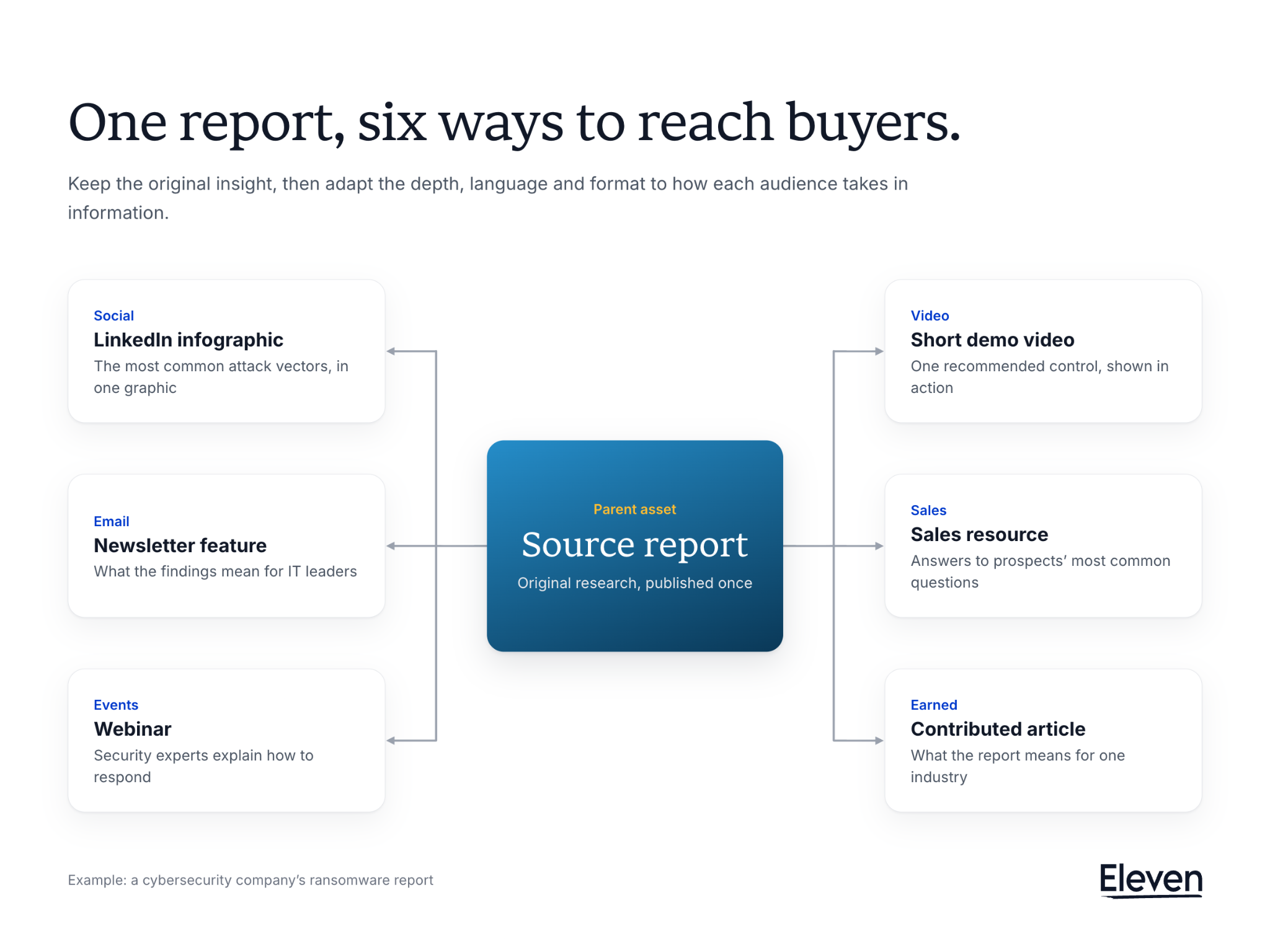
Repurposing involves adapting a piece of content into new formats for different channels and audiences. For example, you might turn an original research report into a webinar, newsletter feature, and several social graphics. Doing so extends the life and reach of your strongest work without requiring you to develop every asset from scratch.
It also creates a halo effect with prospective customers. An Adobe survey of 517 small-business owners found that 52% cited greater brand visibility as a benefit of repurposing, while 49% reported engagement increases of 11% to 25%.
Still, effective repurposing involves more than copying the same material across platforms. Each version should preserve the original insight while reflecting how people use the new channel.
These steps can help you adapt and re-release your best assets effectively.
Choose assets worth repurposing & map them to new channels
First, identify assets that have performed well, contain distinctive research or expert insights, or address a recurring audience need. For example, a CRM benchmark report comparing sales-data quality across industries would be a strong candidate if it continues to attract website traffic and backlinks and customers regularly mention its findings in sales conversations.
Next, isolate the elements most likely to interest audiences elsewhere, such as a surprising statistic, practical framework, expert explanation, or useful demonstration. Match each element to a format and channel that suits how the intended audience consumes information.
For example, a cybersecurity company could turn a detailed ransomware report into:
- An infographic for LinkedIn highlighting the most common attack vectors
- A newsletter summarising the implications for IT leaders
- A webinar in which its security experts explain how to respond
- A short video demonstrating one recommended control
- A sales resource addressing common questions from prospective customers
- A contributed article exploring the report’s implications for a specific industry
Adapt the depth, language, and presentation to each channel. A social post may highlight one striking finding, while a webinar can examine the evidence and recommendations in greater detail.
Sequence releases to sustain reach
Avoid publishing all repurposed assets at once. Instead, space releases across weeks or months so each one creates a new reason to revisit the central idea.
For instance, the cybersecurity company might publish its full report, share a chart several days later, and feature the findings in its next newsletter. It could then host a webinar the following month and publish industry-specific commentary as relevant news develops.
Build sequences into your distribution plan before launch, leaving room to prioritise the formats and findings that attract the strongest response. This approach extends the campaign’s useful life without repeating the same message.
6. Co-create Research, Reports, & Case Studies
Customers, contributors, and partners can help distribute content to audiences your brand may struggle to reach.
Beyond that, their participation acts as a de facto endorsement: By attaching their name and reputation to your work, trusted third parties and first-hand users signal that your brand and its ideas deserve attention.
Their mentions—a critical driver of AI search citations—also hold sway with prospective customers. LinkedIn research conducted with Bain and NewtonX found that B2B buyers were more than 20 times as likely to choose a vendor that everyone in the buying group had heard of at the start of the purchase process.
These strategies can help you turn customer, contributor, and partner relationships into credible endorsements and effective distribution partnerships.
Co-sponsor research and reports
Partner with an industry association, customer, or complementary business to produce research neither organisation could complete effectively alone. Choose a collaborator with relevant expertise, access to respondents or data, and an audience that would value the findings.
To find potential partners, review your existing customer and business relationships, identify associations serving your target audience, and look for organisations publishing research on related topics.
Before production, agree on the research question, responsibilities, funding, data ownership, branding, and publication terms.
For example, if you market a CRM platform, you could partner with a revenue-operations association to survey sales leaders about data-quality problems. The association could recruit respondents and provide independent commentary, while your customers contribute real-world examples and your team analyses the findings.
Both organisations could be credited as co-authors, with the full report published on your website and a summary featured in the association's newsletter, linking back to the original.
Feature outside voices in your content
Invite customers, practitioners, and independent experts to contribute to your content. Their firsthand experiences and specialist perspectives can strengthen your work while giving contributors a reason to share it with their professional networks.
Useful contributions might include:
- Customer quotations and case studies
- Interviews with practitioners or specialists
- Expert panels and roundtable discussions
- Independent reviews of technical claims
- Guest commentary in articles, reports, or newsletters
For example, an AI software company could feature a customer's experience and an independent cybersecurity expert's insights in a report on AI security risks. Once published, the customer could share the report with industry peers, while the cybersecurity expert could highlight their findings on LinkedIn or in their newsletter, introducing your research to new audiences.
Confirm quotations, credentials, permissions, and disclosures before publication, and discuss promotional opportunities with contributors in advance.
Post-publication, provide approved copy, graphics, and tagged links that participants can adapt for their audiences. For example, give the cybersecurity expert a LinkedIn graphic highlighting their key finding, with a link to the full report.
7. Participate in Professional Communities
Professional communities are online spaces where people in the same industry, role, or area of interest exchange advice, ask questions, and discuss shared challenges. Popular examples include:
- Reddit: A public network of topic-based discussion forums called subreddits
- LinkedIn Groups: Professional groups organised around industries, roles, or shared interests
- Slack communities: Private or invitation-based workspaces with topic-specific discussion channels
- Discord servers: Public or private communities with text, audio and video channels
- Stack Exchange: A specialist Q&A network popular with technology, engineering and science professionals
- Quora: A public, general-interest platform where users ask and answer questions
- Professional association communities: Member forums operated by industry bodies and professional organisations
These spaces can help surface your brand’s expertise to highly engaged audiences looking for practical advice from their peers. A 2026 Clutch survey found that 64% of regular community users participated daily, while 98% trusted recommendations from other members.
The emphasis, however, should be on expertise rather than promotion. Many platforms and individual groups restrict commercial content, and engaged members quickly reject contributions that don’t add genuine value.
These steps can help you find relevant communities and participate appropriately.
Identify communities your audience actively uses
Use your audience's job titles, professional interests, and recurring challenges to find communities where they're likely to exchange advice and discuss industry issues.
To narrow your search:
- Ask customers, internal experts, and sales teams for group suggestions.
- Review sales calls, support tickets, and customer interviews for mentions of relevant groups.
- Search Reddit, LinkedIn, Slack, and Discord using your audience's job titles and industry terms.
- Check professional associations for member forums and specialist groups.
- Look for communities that frequently appear in relevant Google and AI search results.
Confirm that recent discussions match the problems your product or expertise can genuinely address. Prioritise a few active, relevant communities rather than joining dozens you can’t support.
This chart illustrates what the community-selection process and its results might look like for three B2B companies.
>> LEARN MORE: How we built brand awareness & leads for ESS Expo 2026
Learn and follow each community’s rules
Platform-wide policies are only the starting point. Individual subreddits, groups, workspaces, and servers often set restrictions around links, promotions, direct messages, and brand participation.
Before posting, read all rules and review recent discussions to understand what moderators and members consider useful. If promotional guidelines are unclear, ask a moderator before sharing branded content or proposing an AMA.
The chart summarises common restrictions, mistakes, and safer approaches across the more well-known platforms.
To avoid issues across platforms, follow these core rules: (1) Contribute useful information directly rather than making members click for the answer, and (2) Disclose your company affiliation and share branded resources only when they add relevant evidence, detail, or practical support.
8. Syndicate Content Selectively
Content syndication is the practice of republishing an existing asset through a third-party publisher, partner, or distribution network. Unlike a guest post created for another website, syndicated content has usually already appeared on your website.
Common examples include:
- Republishing an article on an industry publication
- Sharing an excerpt through a partner newsletter
- Offering an association an existing guide for its member resource centre
- Distributing a gated report through a specialist B2B content network
- Having an article republished by a large content aggregator or news portal, like MSN or Yahoo Finance
Syndication can expose your content to audiences that might not otherwise visit your website, without requiring a bespoke asset. Research suggests it’s particularly valuable for B2B marketers. Per Sagefrog, content syndication and partner networks tied for the top source of qualified leads, cited by 36% of respondents.
The catch: Content syndication works best selectively. An irrelevant publisher may deliver impressive reach but few valuable readers, while careless republication can make it harder for search engines to identify the source.
These steps can help you avoid issues.
Choose the right publishers
Start with the audience and outcome defined for the original asset. Look for publishers, associations, and partner networks that reach the same roles, industries, or buying groups.
Before approaching a syndication partner, review:
- The publisher’s audience, coverage areas, and geographic reach, using its media kit or tools like Similarweb
- Its reputation and authority, using backlink data from Ahrefs or Semrush to assess who's linking to its content
- The quality and relevance of its existing content, including whether it covers topics your audience cares about
- Reader engagement, such as article comments, social shares, and newsletter interactions
If the publisher looks promising, discuss the following terms and confirm them in a syndication agreement:
- Whether it republishes full articles, excerpts, or rewritten versions
- Whether the arrangement includes backlinks, lead details, or performance reporting
- Any fees, exclusivity terms, or restrictions on future use
For example, an environmental-solutions company looking to syndicate a guide to upcoming waste regulations could shortlist trade publications and professional associations read by sustainability and compliance leaders. It could use Similarweb to compare their audiences, Ahrefs to assess their reputations, and recent articles and social engagement to gauge their relevance.
After selecting a partner, the company could negotiate an excerpt in its member newsletter, with a link to the full guide and reporting on referral traffic. Those conditions would help it reach relevant prospects while retaining traffic to its website.
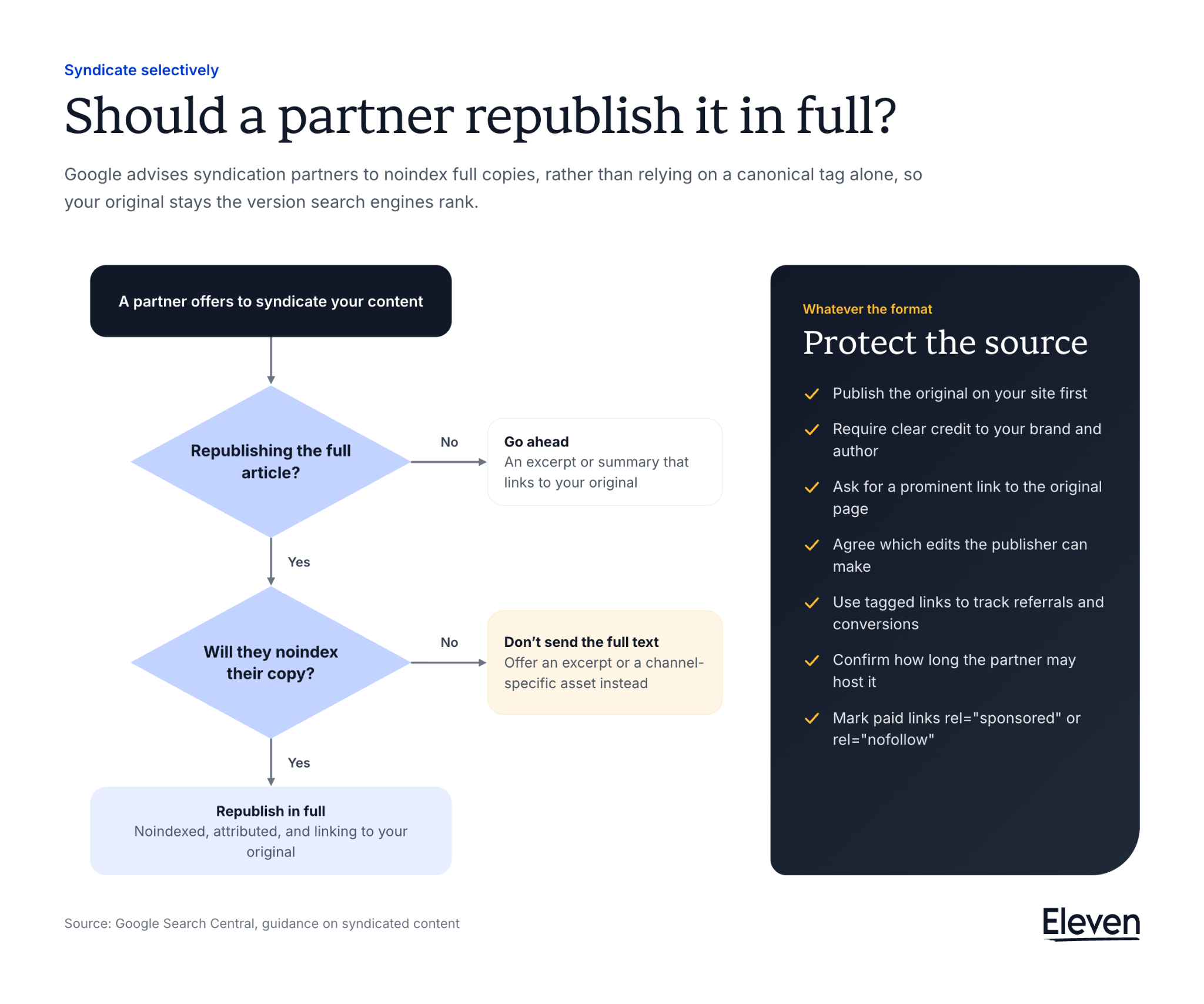
Protect the source
Once you've agreed on a distribution arrangement, take steps to protect your original content's visibility in search results.
Without clear attribution and technical safeguards, readers and search engines may treat the publisher’s copy as the primary source, costing your website traffic, links, and recognition.
To reduce this risk:
- Publish the original version on your website first.
- Require clear attribution to your brand and author.
- Ask for a prominent link to the original page.
- Agree on which edits the publisher can make.
- Use tagged links to track referral traffic and conversions.
- Confirm how long the partner may host and promote the content.
- Ensure paid links use the rel="sponsored" or rel="nofollow" attribute.
If the partner republishes the full article, ask it to block search engines from indexing the duplicate. Google recommends that syndication partners use a “noindex” tag to do so. It advises against relying solely on a canonical tag because syndicated pages can differ substantially from the original.
If the publisher won’t use a “noindex” tag, offer an excerpt or a related, channel-specific asset that draws on the original without reproducing it.
For example, a CRM provider might publish its full benchmark report on its website, then give a revenue-operations newsletter a short article examining one standout finding, accompanied by a simplified chart and a link to the complete report and methodology.
Turn Every Strong Asset Into a Distribution Campaign
Even exceptional content can underperform if it's restricted to your website. To build brand visibility, authority, and demand, share your expertise across the publications, newsletters, social platforms, podcasts, and communities your customers trust.
Eleven’s “Expertise, Everywhere” approach builds distribution into your content strategy from the start. We help brands create expert-led assets, adapt them for relevant channels, and earn wider reach through partners, contributors, and credible third parties.
Contact Eleven today to discuss a distribution strategy that puts your best content in front of more prospective buyers.
Receive insider tips straight to your inbox.

Receive insider tips straight to your inbox.

Would you like to speak to one of our experts?
Create custom email campaigns, measure performance, and turn insights into results with Mailchimp’s email marketing tools.
